Simeon and Anna have been waiting for God’s promise to be fulfilled. They represent all that has happened in Israel’s history before this moment. What kind of Messiah were they expecting? Simeon had been assured that he would not die before this moment came and he is there to welcome this family who must have seemed ‘ordinary’ and poor. Simeon can see that this child will be ‘a light for revelation to the Gentiles and for the glory of your people Israel’. Already there is a note of reversal; of boundaries being stretched. Mary is told that this child ‘is destined for the fall and the rising of many’. There will be trouble ahead; there will be challenges for many. Simeon knows that many thoughts will be exposed, what people really think will be revealed, who they welcome and who they exclude will be challenged; for God’s invitation and welcome has no boundaries. Anna rejoices for all those who were looking for the redemption of Jerusalem. In this statement she knows that this child will overturn systems of oppression and exclusion.
Luke is interested in how humanity responds to the Gospel. If Jesus’ message is really good news, then this requires a shakeup; a shakeup which challenges comfortable assumptions about the way God works. God’s abundant invitation to all may not sit comfortably with many. While Anna prays and fasts for a change of heart in the way Jerusalem operates, Simeon warns Mary that this will not be an easy road.
Ramblings of a Climate Pilgrim... In October 2018 I embarked on a 1,000km walking pilgrimage to COP24, the UN Climate Summit. Here are some thoughts before, during and after.
Saturday, 27 December 2014
Let us go now to Bethlehem (Luke 2:1-14)
If you were to put together a guest list for the birth of the Messiah 2000 years ago, many would find it completely unbelievable and shocking that the shepherds would be included. Shepherding was a disreputable trade; shepherds were outcasts, considered ‘unclean’ because of their profession. People instead would have expected political leaders like Caesar Augustus, religious leaders such as the Chief Priests and the Pharisees and so on. Yet for Luke, the shepherds are the first to hear the Gospel of Jesus and they are the first ‘preachers’ of the Good News. At first they were terrified, but the angels reassured them: ‘do not be afraid’. The response of the shepherds was immediate: ‘let us go now to Bethlehem and see this thing which has taken place’.
Jesus did not find hospitality in his own city, yet he will be the one who will show the abundance of God’s hospitality. The poor, the marginalised, the outcast will be the first to experience it and the shepherds come in their name. We are told that people were amazed by the shepherds and their words. Their journey didn’t end in Bethlehem, for them it was perhaps only the beginning as they returned ‘glorifying and praising God’. We are invited to Bethlehem today, to open up our hearts to the One who has come to bring hope and joy. And we return, like the shepherds ‘glorifying and praising God for all they have seen and heard’. Shalom.
Sunday, 21 December 2014
Fourth Sunday of Advent (Luke 1:26-38)
We sometimes distance ourselves from the real encounter in today's Gospel. As Margaret Silf notes, we sometimes “put Mary into a glass case, surround her with flowers, and avoid the personal consequences of this moment”. And there could have been very severe consequences for Mary, even death by stoning. Mary’s yes is an example of completely surrendering to God’s will. She surrenders her motherhood, her entire life to God.
We can think today of those who mother against the odds in our world. In places where there is no food, no clean water, the threat of disease, of torture; those who watch their children suffer from addiction or violence. And we remember those who are the angel Gabriel’s of the world, bringing good news and hope that ‘nothing is impossible’.
“Hail Mary, woman of Nazareth, home maker, cleaner, preparer of food, fetcher of water, God is with you in your everyday excursions in this ordinary town. Blessed are you among women and blessed indeed are women in their everyday lives, in the confines of family life, in the ambivalence of decision making, in the silences and blessed are the fruits of all our labours”. Janet Lees
Saturday, 13 December 2014
‘A witness to speak for the light' ~ Third Sunday of Advent 2014
There is so much darkness around us: in the church, in the troubled parts of the world, in our own families and even in our own hearts. It is easy to become cynical. The Gospel today tells us that John the Baptist was someone who was ‘a witness to speak for the light.’ He gave hope to people. We can think of many people in society today who witness to the light. One that comes to mind is Malala Yousafzai. Malala was shot by the Taliban on her way to school in Pakistan. She was targeted for speaking out on the rights of women to education. She has said: “We realise the importance of our voices only when we are silenced. I was shot on a Tuesday at lunchtime, one bullet, one gunshot heard around the world.” Malala was in her chemistry class when she heard she was to be the youngest ever recipient of the Nobel Peace Prize. She celebrated by going on to a physics class.
Look around your families and communities and you will see many who witness to the light. We each have the capacity to do the same, however dark the situation may be. The Gospel challenge is to bring hope and good news. We should take example from the Malala’s of the world.
“They bear witness to the rest of us that somewhere in the dark a light always shines, a light that darkness cannot overpower, and therefore we can all believe again.” Michel de Verteuil.
Thursday, 4 December 2014
Advent 2 (Mark 1:1-8) "Prepare a way"
John the Baptist is an interesting character. He was not someone who kept up with the latest fashion. We are told he wore strange clothes, ate insects and lived in the desert. And yet John was very popular as we hear that ‘all of Judea’ came to him. There was obviously something very attractive about John. People could see something in him; something that inspired them; something that gave them hope. John is clear that he is not the one they are looking for; rather he is someone who is pointing to the one they are looking for. John shows the way for people, he is a signpost to God.
The world says to God, ‘we no longer need you, we know what is best’. And then we look at the wilderness of our modern world and hear the voice of one crying, “Prepare a way”. How do we prepare for welcoming God’s love into our hearts? God is crying out for us to welcome him again and again. It is us who are blocked; we put so many things in the way. John is urging us to clear the path, to let go of all the things that are preventing us from experiencing God’s love. John is calling people out from despair into hopefulness.
Sunday, 30 November 2014
First Sunday of Advent 2014
You know that feeling of waiting for something or someone? It is a feeling of excitement or maybe anxiety. It can be a creative time, a time of high alert, where we may even be more aware of ourselves. Our senses are heightened especially when we are waiting for important news or results or waiting on a loved one to call or to arrive. Waiting is not always seen as a good thing but it can be a time for growth. And so, we enter into the season of waiting: Advent.
These weeks are weeks of great hope and joy and we celebrate God entering into our lives once more. This short passage from Mark reminds us to be alert, to use this time to prepare. What will our preparations be like? God is with us in many different ways, trying to catch our attention in the midst of our crazy, busy days. As we fight our way through the queues in the coming weeks, can we use 5 minutes, 7 minutes, 20 mins… to stop, be still, to ask God to enter into our hearts and lives once more.
Saturday, 22 November 2014
What kind of King?
The Feast of Christ the King is the final Sunday in the liturgical calendar. To understand more fully what this feast means we need to lay aside a lot of the cultural baggage about Kings and Kingdoms. Jesus’ Kingship is very different to the kind we are familiar with. There are no trappings, no palaces, no pomp and ceremony. The picture painted by today’s Gospel shows us Jesus as a King who is found in those considered to be on the very fringes of society. This passage comes at the end of Matthew’s Gospel and it is a challenge, a call to be Christ to others and to see Christ in others.
With so much brokenness in the world, so much unrest, so much war and displacement, the Christian community are called to him by giving our own lives in service to those around us; we are called to be transformative through radical solidarity. There are no shortage of causes, whether it be Gaza, Iraq, Syria, climate justice, austerity, local poverty, visiting the sick or those in prison, community initiatives… Jesus’ Kingdom is built on a different kind of foundation.
“If now we have no peace, it is because we have forgotten how to see God in one another. If each person saw God in his neighbour, do you think we would need guns and bombs?” Mother Teresa
Sunday, 16 November 2014
Talents ~ Sunday 16th November
The parable we read today is not a lesson in capitalism. We must bear in mind that Jesus is frustrated with those who had been entrusted with ministering to His people. They had excluded the people and laid heavy burdens upon them. When we read the parable in this sense we can understand the exasperation of the Master. The talents should have been used to transform people’s lives; used for embracing those on the margins; for standing up against injustice and inequality in the world. Yet many were afraid or blind to this, so they hid the talents and did not multiply them. It is a safer place to be.
Compare this outcome to the other servants. There is a beautiful verse in both cases which reads “enter into the joy of your master”. Is this not what happens when we find that path that is right for us? Joy! When we use our talents and gifts in work or projects that are life giving and meeting the needs of our communities? Joy is a fantastic emotion; a sign of God’s grace. Despite the frustrations of whatever work we are involved in, the presence of joy is one sign that we are on the Kingdom track. The challenge is not to be afraid to go out there. Pope Francis asks that we have the ‘smell of the sheep’ and calls us to “be courageous. A Church that does not go out of itself, sooner or later, sickens from the stale air of closed rooms”.
Thursday, 6 November 2014
Sunday November 9th 2014 ~ Cleansing of the Temple
Today we celebrate the dedication of the Basilica of St. John Lateran, historically the oldest church in Rome. It was the residence of the Pope for centuries and remains his cathedral. It is considered the mother of all churches! Our Gospel passage for this feast almost seems to be in contradiction as it recalls Jesus cleansing the Temple in Jerusalem.
The theology of the Temple was such that to get to God you had to qualify culturally, socially and in terms of ‘purity’. The goods sold in the Temple markets were used in sacrifices so that people could meet the requirements to be ‘closer’ to God. You can understand why Jesus was angry and challenged this model. He tells people early on in John’s Gospel that HE is God’s Temple. God cannot be confined. Jesus’ words are too controversial for his listeners and challenging such powerful structures comes at a price.
We can take away many reflections from today’s feast: we celebrate the church as a place of encounter with God; we are also reminded that God is not confined to one building or the structures placed around it. We gather as community in prayer and worship in our churches united with Christians all over the world, yet we remember that it is the people who gather there in Jesus’ name who are the real church. The Temple of God is the Christian community, the body of Christ with Jesus as its foundation. This is pre-echoed in the second reading today from St. Paul when he says: “For the Temple of God is holy and you are that Temple”.
“Come to me… and I will give you rest” ~ Remembering
In all our lives we carry many burdens. Sometimes we carry them in such a way that they help us grow, at other times we allow them to eat away at us, making them very heavy indeed. Jesus is not saying that we will not have burdens to carry. But He is telling us to find rest in Him. Jesus is offering refreshment and peace. Even when those we love pass into eternal life, we are consoled in knowing that they are at peace and that we will be united with them again.
We perform many rituals in remembering the dead, especially in the month of November. Today we might light a candle, say a prayer, visit a church or grave, look at old photographs. We can be thankful for the many ways in which our loved ones shaped us, cared for us, and who are with us as we continue to journey through life.
“We are who we are today and we are where we are today, because of those whose lives have touched ours and who have let our lives touch theirs. God, in the magnificence of things, does not intend us to be neutral when we lose those who have loved us. So, our grief has to be tinged with gratitude for lives which have shaped us, for hands that have held us, for voices that have inspired us, for eyes which have beheld us, for ears that have listened to us.” (Unknown Author).
Saturday, 1 November 2014
Nov 1st All Saints Day Matthew 5:1- Blessed are the peacemakers…
Sister Megan Rice is eighty four years old and is currently seven months into a three year prison sentence for breaking into a US Security Complex in Tennessee. She, and her co-conspirators, sprayed bible quotes and blood on the walls of the heavily guarded, $500 million Highly Enriched Uranium Materials Facility. When guards came to arrest them they found them singing hymns and were offered the chance to break bread and read the bible with the intruders. The offer was declined. Sister Megan's actions are rooted in the call to "hammer swords into plough shares", i.e., convert weapons into peaceful tools (Isaiah). Their action has been called "the biggest security breach in the history of the [USA’s] atomic complex." At her trial, she was asked if she had anything to say, she replied, "I regret I didn't do this seventy years ago."
Sr. Megan is a peacemaker, what some would call an ‘urban saint’. Saints are all around us, pointing the way for us, teaching us something about God through their lives. They persevere in all they do for their families and communities, especially those on the margins. They are the blessed ones. The Megan Rice’s of this world are an inspiration for us to strive to live the beatitudes in our daily lives. Matthew’s community would have been very familiar with what it means to be persecuted because of their beliefs and the final beatitude calls for perseverance. Perhaps that is the making of all saints.
Saturday, 27 September 2014
The Parable of the Two Sons & Homeless Jesus (Matthew 21:28-32)
The ‘Homeless Jesus’ statue was sculpted by Timothy Schmalz (sculpturebytps.com), to bring attention to the chronic problem of homelessness in Toronto and depicts a homeless person on a bench, covered in a blanket. On closer inspection there is a noticeable characteristic, the person bears the wounds of crucifixion. This is Jesus, the homeless wandering preacher. One particular parish were initially enthusiastic in having the sculpture outside their doors but after some reflection decided against it. Parishioners found it ‘offensive’; ‘provocative’ and ‘not an appropriate image’. One lady even called the police! What a debacle?! The ‘Homeless Jesus’ statue eventually found a home; a place where Christians were not afraid to acknowledge Jesus in the most marginalised. The work is now considered to be a meditation on Matthew 25.
Today’s parable reminded me of that story. The parable is a simple tale about two brothers, one who eventually shows through his actions that he has heard a message, the other who does not. The chief priests listening to the parable are forced to admit that it is the first brother who has acted correctly. However, they are behaving more like the second.
It is almost comical listening to Jesus say: ‘the tax collectors and prostitutes are going into the Kingdom ahead of you’.
‘I have long since come to believe that people never mean half of what they say, and that it is best to disregard their talk and judge only their actions.’
Dorothy Day
Saturday, 20 September 2014
God's Love Is Just Different ~ Mt 20:1-16 (Sunday 21st September 2014)
In today’s parable Matthew is addressing an issue in the community where people are unhappy with certain groups being included in God’s Kingdom… they were there first! We can identify with the characters: times when we felt hard done by; times we made comparisons between ourselves and others. Whereas ‘THEY’? Well, ‘they’ are the cause of the problem, benefiting in some way from our perceived injustice.
“Friend, I am doing you no wrong.” This is a moment of grace where God is freeing people from jealousy; there is enough to go around, everyone has received what they were promised. Even in our relationships with one another, people sometimes want to possess and take all for themselves. In reality God (and people) can love others unconditionally without taking anything away from us. If we could liberate ourselves from such insecurities and not let them take hold, life would be a lot happier. Have you been wronged? Has an injustice occurred to anyone else? No, then why worry? The workers expect a judgemental God and often we too confine our image of God to a distributor of justice. God’s justice is more concerned with generosity and compassion, there is plenty for all. God’s love is just…different.
“True love is delicate and kind, full of gentle perception and understanding, full of beauty and grace, full of joy unutterable... With such a love one would see all things new; we would begin to see people as they really are, as God sees them.” ― Dorothy Day
Saturday, 6 September 2014
A divine attribute (Matthew 18:21-35) Sunday 14th September 2014
Ten thousand talents today are estimated to be in the hundreds of millions! So it would be a foolish King who would allow a ‘servant’ to clock up debt to that mount (you would think!). Even though his debt is completely cancelled, the ‘servant’ is not so forgiving when it comes to his own household. One denarius would be the equivalent of the wages of a labourer for a day, so one hundred day’s wages is a drop in the ocean in comparison. Those who witness these events are ‘greatly distressed’ and decide to protest. You don’t have to look too far today to draw parallels to this parable.
Peter asks a vital question: how many times do you forgive? The answer may disturb some people but it can also liberate us if we allow it to: seventy–times– seven, i.e. an infinite number of times. This might seem idealistic and even ridiculous, but when we think more about it there is no other option. Without forgiveness we allow bitterness to engulf and torture us; zapping our energy; preventing us from being at peace with ourselves. When we only seek retribution, we enter into chaos.
“To forgive is to set a prisoner free and discover that the prisoner was you.. When we forgive evil we do not excuse it, we do not tolerate it, we do not smother it. We call it what it is, let its horror shock and stun and enrage us, and only then do we forgive it.” (Lewis B. Smedes)
Labels:
forgiveness,
Gospel,
homily,
matthew 18,
sermon
“I shall be there with them” (Matthew 18:15-20)
Matthew 18 is a discourse on relations within the Christian community and today’s Gospel gives some very practical advice about a problem we all encounter: conflict. The beautiful phrase ‘you have won back your brother’ highlights the importance of resolving our differences with one another; love sometimes involves confrontation. We may involve others to help mediate but only when the first stage has failed. To seek help requires great humility and involving the wider community may seem harsh, but we should not be naïve, lasting peace sometimes requires mediation.
There is an unusual verse referring to tax collectors and Gentiles and the drastic steps that are taken in order to protect the community. Perhaps it is these groups of people who are calling on the community to face facts and to move forward. Mediation is not an easy task, whether it be a parent dealing with conflict in the family; a diplomat brokering peace-keeping deals in conflict zones; a counsellor journeying with two people; conflict is all around us. Today’s Gospel urges dialogue, patience, perseverance and the space to allow grace to enter.
“The conclusion of our meditation is not ‘Jesus tells us to do this,’ but, ‘Let us celebrate Jesus at work in the world.’ We recognise moments of grace when we ourselves lived this teaching, and celebrate the great people who by word and example taught us to live it.” (Michel de Verteuil)
Saturday, 26 July 2014
"Treasures, pearls and suspended coffees..." Sunday 27th July Mt 13:44-52
I recently wandered into a café in Dublin that was selling ‘suspended coffees’. This is where you buy a coffee and then buy another one ‘suspended’. Then someone who can’t afford to buy a hot beverage can come in and ask for a ‘suspended coffee/tea’. It reminded me of one of today’s parables, the treasure in the field. 'Suspended Coffees' gave me a tiny glimpse of what the world looks like when we take this Kingdom of God stuff seriously. It brings great joy, especially when it is unexpected. Sometimes there are hidden treasures of God’s kingdom going on right under our noses (remember the mustard seed revolution parable from last week?.
Over the last few Sundays we have heard Matthew 13 and the parables on the growth and development of God’s Kingdom. Today we are told what to do when we find it. It may be unexpected; it may be the result of a long search and journey, but once found, nothing else matters. We are driven by our desires. It is what we desire most that effects what we do and the choices we make in life. In both parables the finder responds wholeheartedly and in complete surrender. We should ask for the ability to make the radical decision for the treasure. Jesus tells us that there is only one thing worth pursuing at any cost – that is the Kingdom of God. And JOY is one proof of its presence.
(Find your nearest suspended coffee: www.suspendedcoffees.com )
Monday, 21 July 2014
The Mustard Seed Revolution: 20th July Mt 13:24-43
The mustard seed parable is often explained away by stating how God takes a tiny seed and makes a big tree out of it. There is, as usual, a lot more going on here. Matthew strategically places the mustard seed parable in the middle of a story about gardening. Jesus surprises his listeners by telling them not to cut the weeds out of the wheat. The mustard seed’s growth could also be compared to wild weeds that grow through cracks in footpaths or a vine that vigorously takes over an area.. There is an ancient text which forbade planting mustard seeds in Palestinian gardens because the shrub takes over, like how yeast works its way through dough! It is wild, out of control, and attracts unwanted birds. Author and activist, Shane Claiborne, compares it to kudzu, a wild vine that could blanket entire mountain areas, smother trees, even crack cement buildings.
People of Jesus’ time may have preferred the image of the lofty ‘cedars of Lebanon’ to explain God’s kingdom, where the nations could build nests like the eagles do. Now that image may have gotten a few cheers from the crowd! Mustard plants however, only stand a few feet tall. Jesus is turning the ideals of power and triumph on their head again. The image we have here is of the unwanted, detestable birds who find a home in this little shrub which cannot be curtailed. It will grow even where it is not wanted.
Saturday, 12 July 2014
The Parable Experience – Engage (Sunday 13th July; Mt 13:1-23)
Parables are not simply a ‘story with a moral’; they are much more than that. Parables speak to the heart and command an alertness to all that is said and all that is unsaid. We need to pay attention to the detail, but must also be careful not to miss the hidden meaning in the parable experience. And it is an experience. The parable does not end once we are finished hearing or reading it. It stays with us; disturbs us; forces us to ponder. Parables should awaken our senses.
This Sunday's parable highlights the various ways that we do not allow God’s word to penetrate deep into our hearts and minds. Jesus tells the disciples: “The reason I speak to them in parables is that ‘seeing they do not perceive, and hearing they do not listen”. Jesus emphasises the enormous harvest that is waiting for those who really ‘open their ears’.
Recently, I saw a YouTube clip of a 40 year old woman who was able to hear for the first time thanks to cochlear implants. It was an emotional clip to watch and she cried and laughed and shouted with joy. She explained how “the switch-on was the most emotional and overwhelming experience of my life”. If we are open to the parable experience, if the soil is truly receptive, perhaps the Word can affect us in the same way. In the coming Sundays we hear the parables of Matthew 13. Perhaps we can hear them again for the first time.
40 Year Old Woman hears for the first time: http://time.com/41427/watch-the-emotional-moment-a-40-year-old-deaf-woman-hears-for-the-first-time/
Saturday, 5 July 2014
“All you who are weary” Sunday July 6th (Mt 11:25-30)
Jesus had little success with the ‘professionals’ of his day. Yet in this Sunday's Gospel He bursts into a prayer of thanksgiving for revealing wisdom to those who are considered ‘infants’. In the context of these chapters of Matthew, it is stressed that the poor are the only ones who truly understand the wisdom of God and they do so under the weight of great oppression and demands placed on them by the religious authorities. For example, the ‘wise’ place their particular interpretation of the law on the ‘ritually unclean’ by excluding them from meals (9:10-13) or place restrictions on the Sabbath that ignore human need (12:1-14).
Jesus wants people to leave aside these oppressors and learn from Him; find rest in Him. His focus is on mercy, compassion and love. This passage shows the tenderness with which Jesus welcomes and accepts. Jesus knows the reality of people’s suffering. He is not saying that there are no burdens in life; but that he will help people to find wisdom. This wisdom gives consolation, tenderness,acceptance and the rest for which the soul yearns.
“Lowliness is humility, and that means down-to-earth realism. I accept myself as the raw material God has chosen to work through. For God can use me if I am ready to be me. God cannot do much with me as I wish I were, and even less with me trying to be someone else. In supple strength and cheerful self-acceptance lies the secret of a calm and restful spirit.” (William Yeomans)
Friday, 18 April 2014
Some Good Friday Thoughts...
The story of the suffering and death of Jesus and the religious services that go with Good Friday are perceived, by the majority of people in Ireland today, far removed from everyday life. This year, for the first time ever I think, I have been quite removed from the liturgical mayhem involved in celebrating the most important feasts of the Church’s year. This is due to an accident I had a few weeks back which has left me incapacitated for the next few weeks. So, while sitting at home all day instead of the usual marathon session in the parish, I have been asking myself what these three days mean to the rest of the world. You could say, I’ve been having a ‘what’s it all about Ted’ sort of day. Apparently we now live in ‘secular’ Ireland; rescued and saved from the mad Christians. Social media feeds today declared all those still participating in the ‘mad rituals’ ‘out of touch’ but comforted the population by assuring them that we [the mad Christians] would soon be extinct.
I thought I’d read the newspaper to get away from Facebook but Atheist Ireland are mightily peed off in there due to the pubs being closed; this is a terrible "affront to non-believers”. And while they probably have a point where the pubs are concerned, I could not help thinking that a national day of non-drinking probably would not do us any harm; A national ‘non-commercial day’ even or a ‘publican’s day off’. “The Good Friday ban is just one annual note in the constant background noise of religious interference in our public life” (Irish Indo).
In an effort to salvage some sort of prayer during the day, I tuned into Pray as you Go. The words ‘I thirst’ jumped out at me. I was thrown back to Malawi, where I visited in January, and I recalled the amazing and wonderful people I met in a tiny village in the Dedza region. They thirst every day. The water they use to quench their thirst makes them sick. They walk hours every day to get that water.Their children are constantly ill and missing school days frequently. In the next 6 years rain-fed agriculture in that region will drop by 50% due to climate change. HIV/AIDS cause further problems and heartache for many in this village.
During the day I was also drawn back to the article about the ‘Homeless Jesus’ statue. This statue, sculpted by Timothy Schmalz to bring attention to the chronic problem of homelessness in Toronto, depicts a homeless person on a bench, covered in a blanket. However, on closer inspection there is a noticeable characteristic: the person bears the wounds of crucifixion on his feet. This is Jesus, the homeless wandering preacher, asleep on a bench outside your house, outside your church. St. Michael’s Cathedral in Toronto were initially enthusiastic in having the sculpture outside their doors but after some reflection decided against it. Parishioners found it ‘offensive’; how could someone do this to their image of God? It was too ‘provocative’ and ‘not an appropriate image’. But it is real. What on earth are they talking about?
People are crucified in this world every day. Jesus shows us from the cross that suffering is very real: while we tend to focus in on the physical suffering, there was intense emotional suffering also. One wouldn’t blame Jesus if he was relieved that this public ministry episode was coming to an end. After all, it had been an epic failure up until this point and he was betrayed and let down by his closest friends in the end. How many of us have not suffered this disappointment or heartache of any kind?
Good Friday is not the end of the story. Nor is it some archaic set of rituals that have nothing to say to the world today. We can participate in services of all kinds today (some will be better than others) but we are constantly being called to the Good News, the HOPELANDIC news. (Like those who hope that the pubs open tomorrow and have a promise that they will). For Christians around the world a celebration is coming and it has a lot to tell us about our lives and the world that we live in. All things are possible.
I think about that small village in Malawi and I know that there is hope. This is the bore well that was installed by Trocaire which is providing water to hundreds of people; clean water; water that has not made anyone sick in months; that has kept a lot of children sick free and in school. That well was made possible through the people who donate to Trocaire each year. As Mandy Meade notes: ‘Never doubt that a small group of people can change the world’.
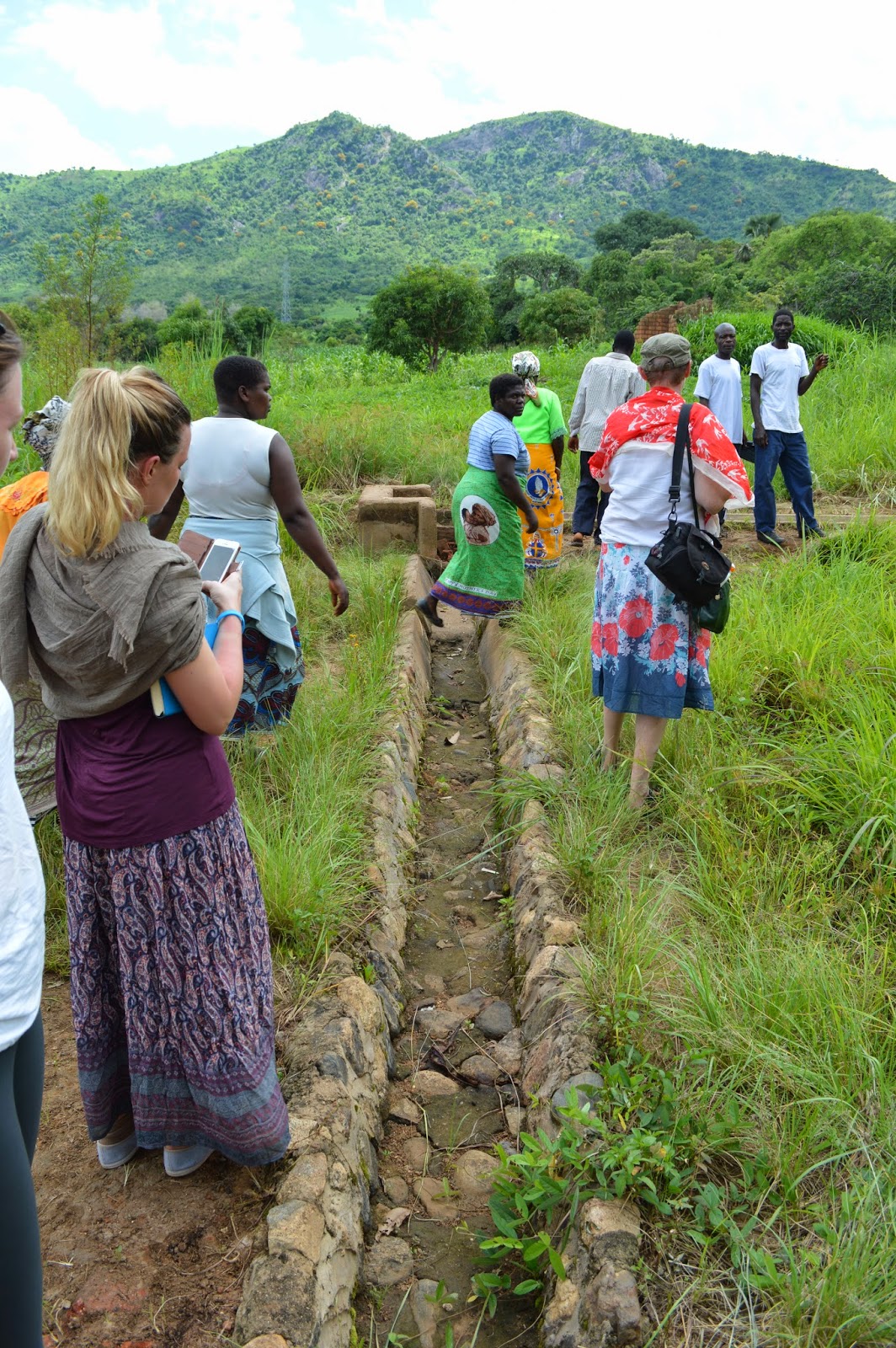
I was also thinking about the irrigation system in a village we visited one day in Malawi. Installed through Trocaire’s partners in Malawi this irrigation system has turned one community from ‘I THIRST’ into a community with two harvests a year. Water flows from the mountains three kilometres away into 28 plots of land bringing crops, feeding a fish farm, and saving the people from the annual ‘hungry season’. We see the crucifixion story in the famine and drought; but we are also called to see something greater; to be something bigger; to cause TRANSFORMATION.
The ‘Homeless Jesus’ statue also has found a home; a place where Christians are not afraid to look homeless Jesus in the eye and say – ‘this oppression; this homelessness: “It is finished”. The sculptor has even been commissioned by many parishes in the USA to bring ‘Homeless Jesus’ to their doorsteps.
These three days of the Easter Triduum are the stories of all our lives, whether we want to engage with it or not. They show the world the reality of suffering but also shine a beacon towards hope, resurrection, transformation, and change of the most unimaginable kind.
Subscribe to:
Posts (Atom)